Woolmark — an introduction
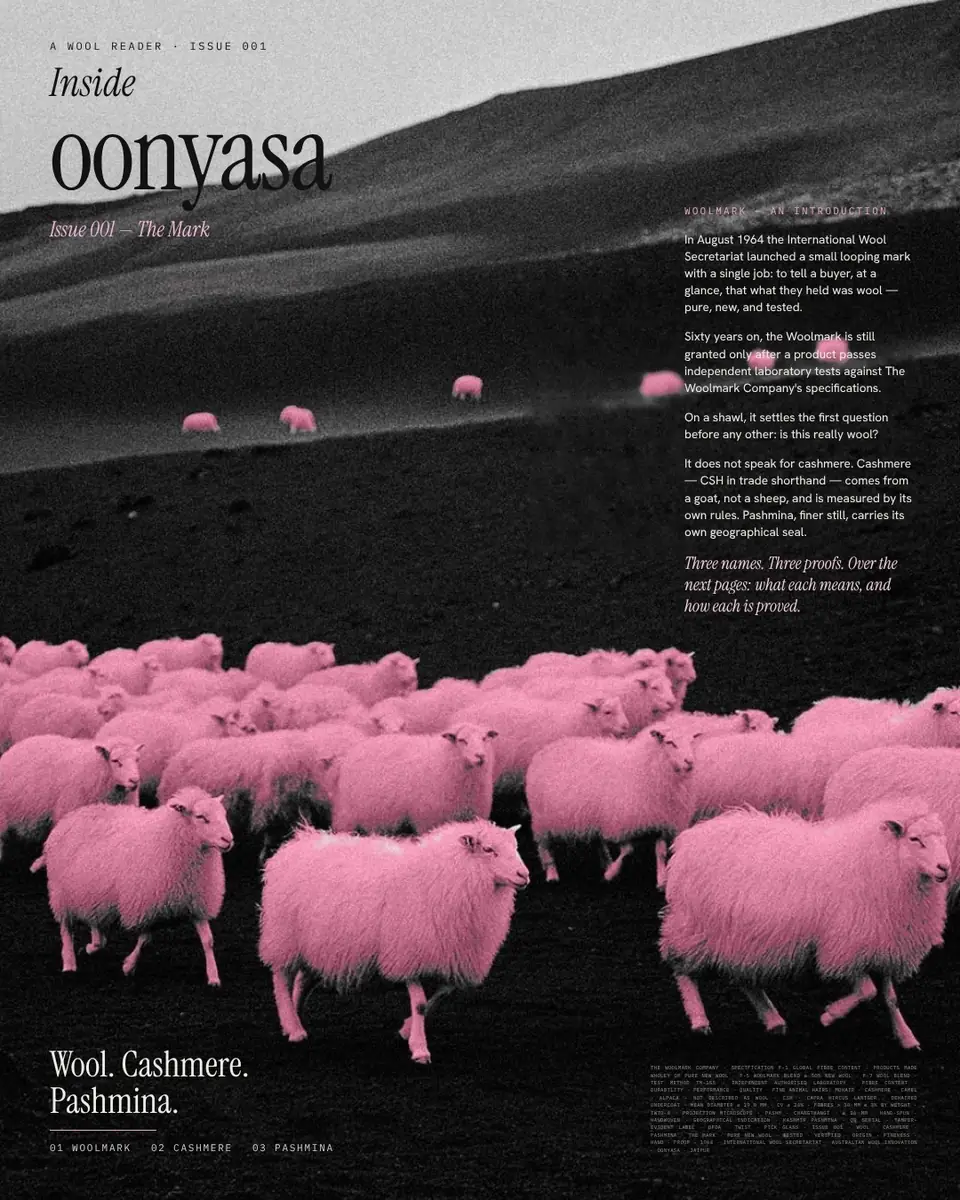
In August 1964 the International Wool Secretariat launched a small looping mark with a single job: to tell a buyer, at a glance, that what they held was wool — pure, new, and tested.
Sixty years on, the Woolmark is still granted only after a product passes independent laboratory tests against The Woolmark Company's specifications.
On a shawl, it settles the first question before any other: is this really wool?
It does not speak for cashmere. Cashmere — CSH in trade shorthand — comes from a goat, not a sheep, and is measured by its own rules. Pashmina, finer still, carries its own geographical seal.
Three names. Three proofs. Over the next pages: what each means, and how each is proved.
Wool. Cashmere. Pashmina.
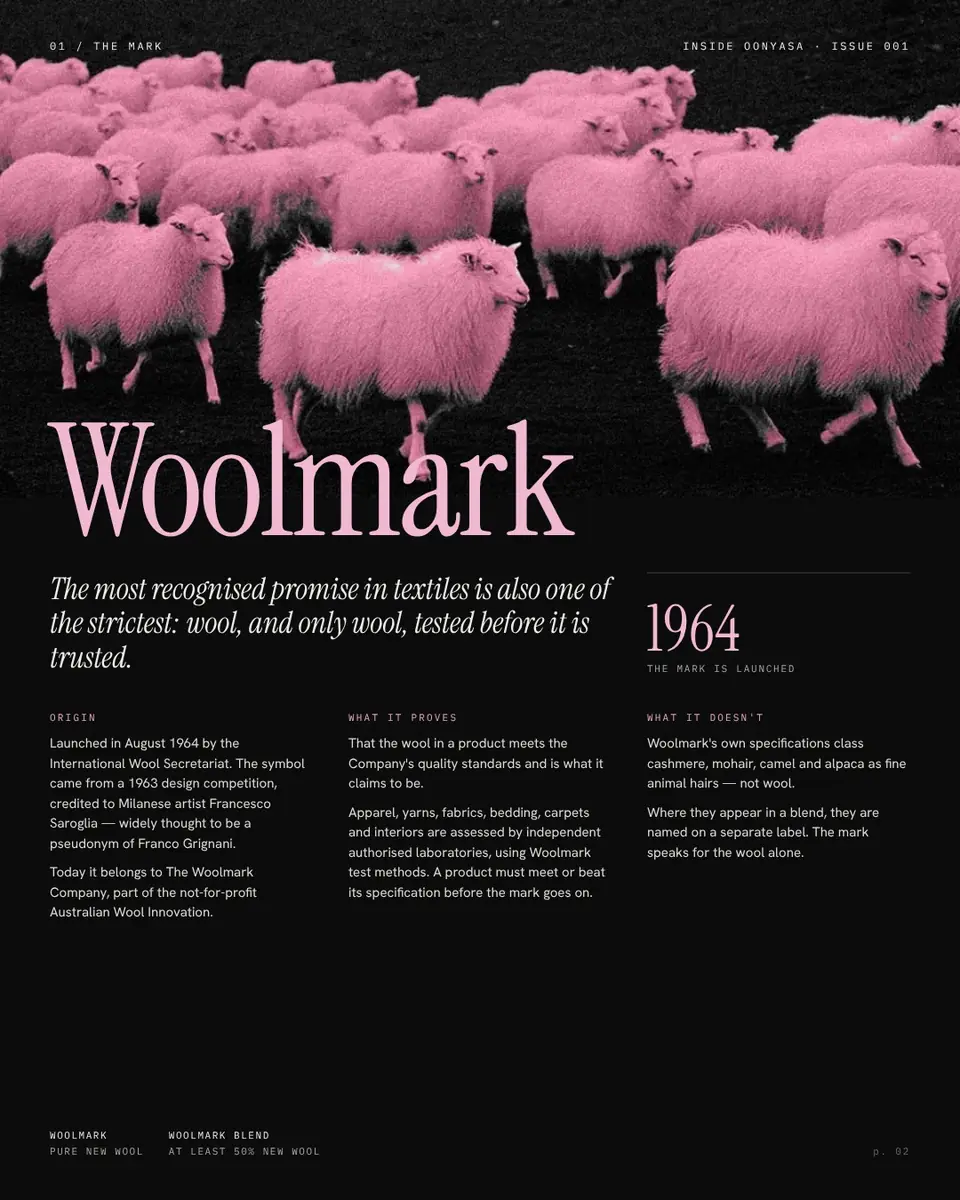
Woolmark
The most recognised promise in textiles is also one of the strictest: wool, and only wool, tested before it is trusted.
Origin
Launched in August 1964 by the International Wool Secretariat. The symbol came from a 1963 design competition, credited to Milanese artist Francesco Saroglia — widely thought to be a pseudonym of Franco Grignani.
Today it belongs to The Woolmark Company, part of the not-for-profit Australian Wool Innovation.
What it proves
That the wool in a product meets the Company's quality standards and is what it claims to be.
Apparel, yarns, fabrics, bedding, carpets and interiors are assessed by independent authorised laboratories, using Woolmark test methods. A product must meet or beat its specification before the mark goes on.
What it doesn't
Woolmark's own specifications class cashmere, mohair, camel and alpaca as fine animal hairs — not wool.
Where they appear in a blend, they are named on a separate label. The mark speaks for the wool alone.
1964 — The mark is launched. Woolmark: pure new wool. Woolmark Blend: at least 50% new wool.
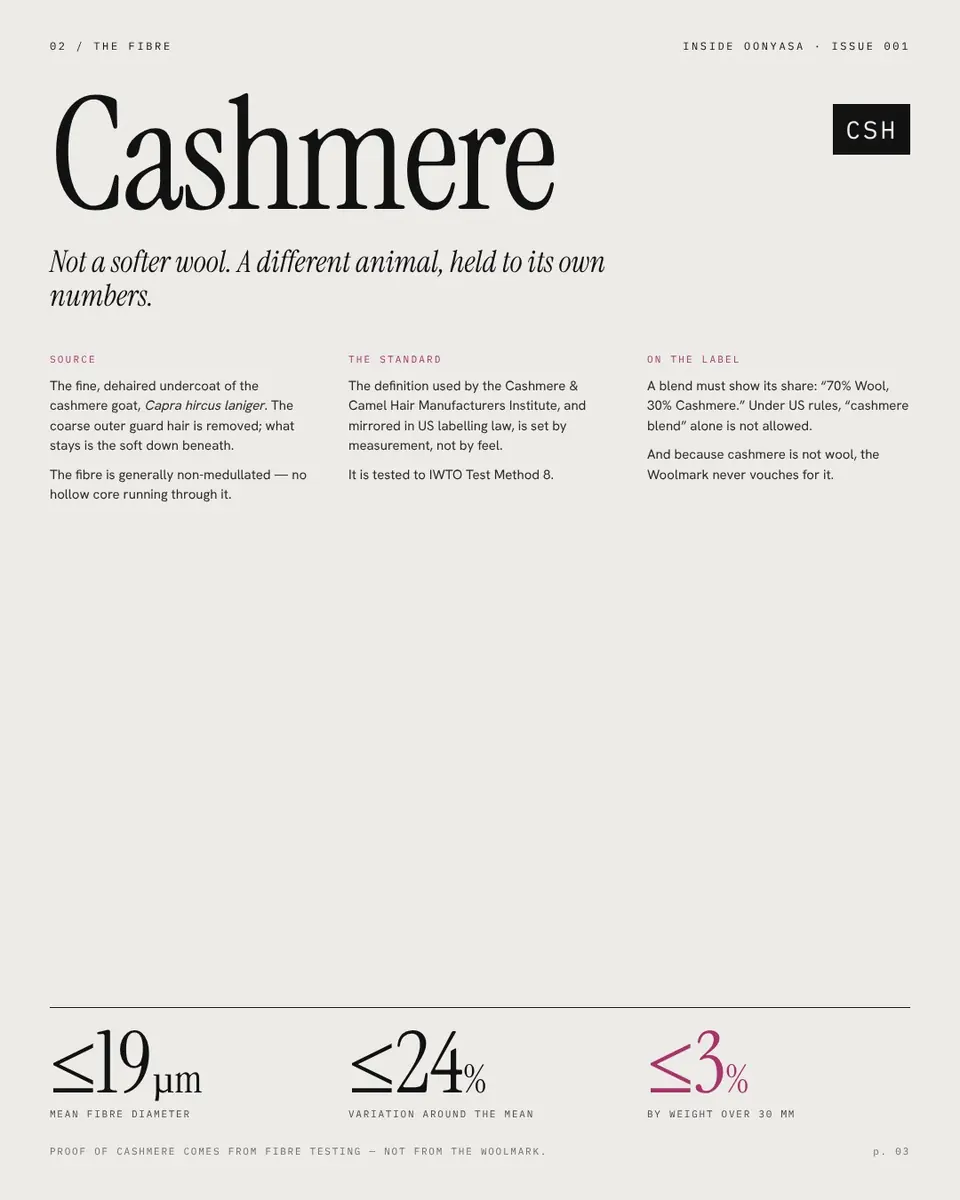
Cashmere
Not a softer wool. A different animal, held to its own numbers.
Source
The fine, dehaired undercoat of the cashmere goat, Capra hircus laniger. The coarse outer guard hair is removed; what stays is the soft down beneath.
The fibre is generally non-medullated — no hollow core running through it.
The standard
The definition used by the Cashmere & Camel Hair Manufacturers Institute, and mirrored in US labelling law, is set by measurement, not by feel.
It is tested to IWTO Test Method 8.
On the label
A blend must show its share: "70% Wool, 30% Cashmere." Under US rules, "cashmere blend" alone is not allowed.
And because cashmere is not wool, the Woolmark never vouches for it.
≤19 µm mean fibre diameter · ≤24% variation around the mean · ≤3% by weight over 30 mm.
Proof of cashmere comes from fibre testing — not from the Woolmark.
Pashmina
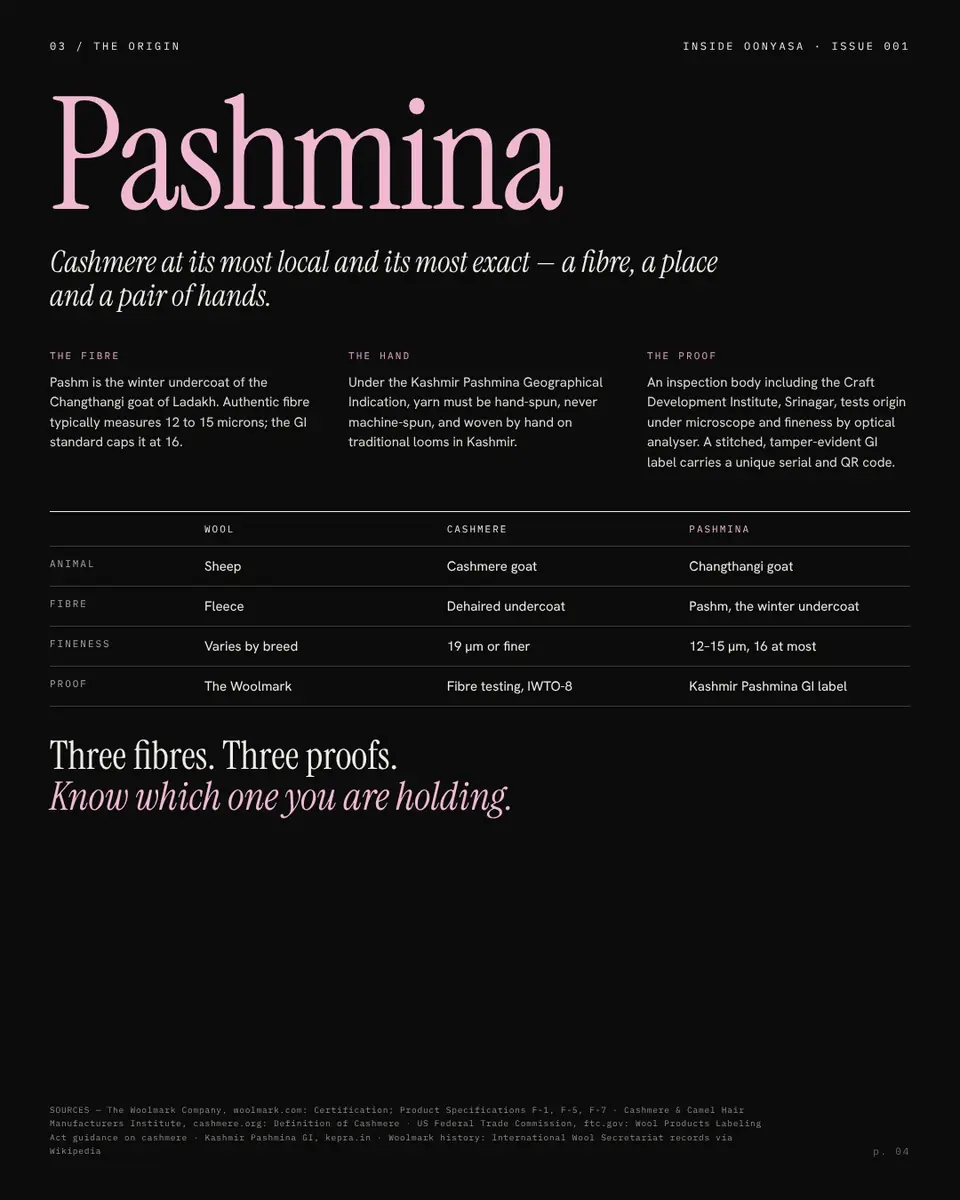
Cashmere at its most local and its most exact — a fibre, a place and a pair of hands.
The fibre
Pashm is the winter undercoat of the Changthangi goat of Ladakh. Authentic fibre typically measures 12 to 15 microns; the GI standard caps it at 16.
The hand
Under the Kashmir Pashmina Geographical Indication, yarn must be hand-spun, never machine-spun, and woven by hand on traditional looms in Kashmir.
The proof
An inspection body including the Craft Development Institute, Srinagar, tests origin under microscope and fineness by optical analyser. A stitched, tamper-evident GI label carries a unique serial and QR code.
| Wool | Cashmere | Pashmina | |
|---|---|---|---|
| Animal | Sheep | Cashmere goat | Changthangi goat |
| Fibre | Fleece | Dehaired undercoat | Pashm, the winter undercoat |
| Fineness | Varies by breed | 19 µm or finer | 12–15 µm, 16 at most |
| Proof | The Woolmark | Fibre testing, IWTO-8 | Kashmir Pashmina GI label |
Three fibres. Three proofs. Know which one you are holding.
Sources — The Woolmark Company, woolmark.com: Certification; Product Specifications F-1, F-5, F-7 · Cashmere & Camel Hair Manufacturers Institute, cashmere.org: Definition of Cashmere · US Federal Trade Commission, ftc.gov: Wool Products Labeling Act guidance on cashmere · Kashmir Pashmina GI, kepra.in · Woolmark history: International Wool Secretariat records via Wikipedia